Why African Non-Europhone Heritage?
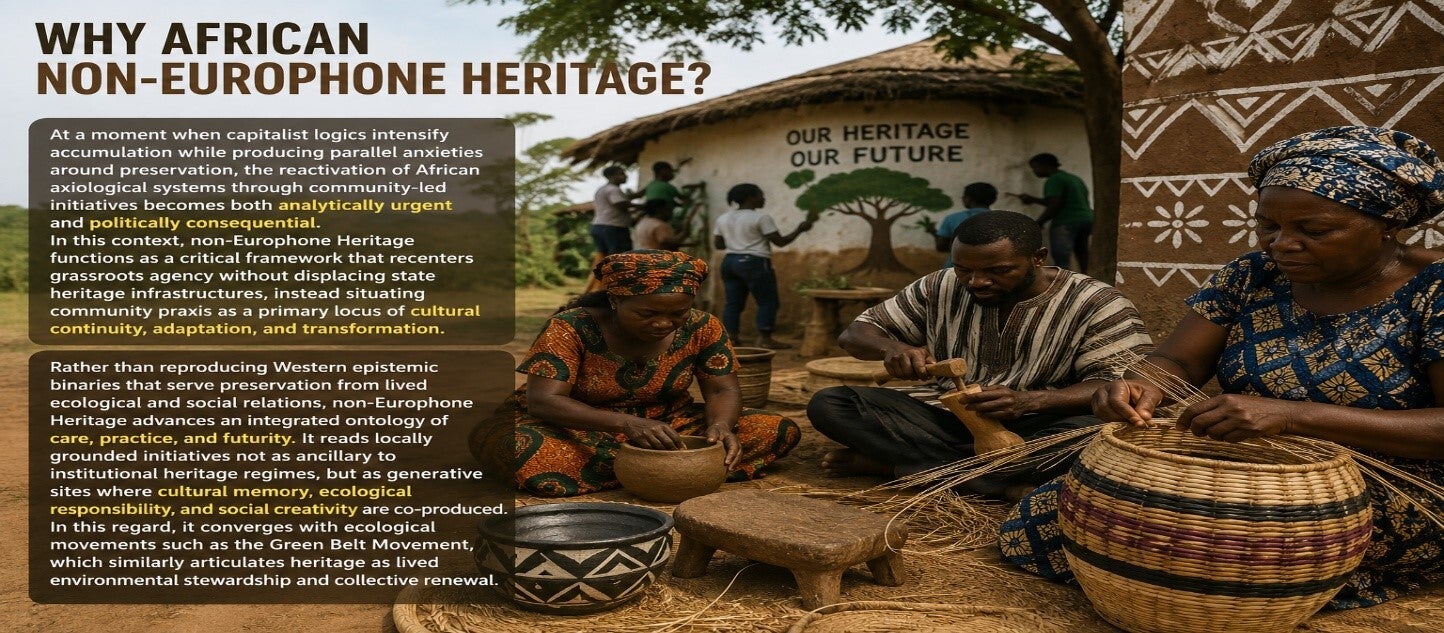
At a moment when capitalist logics intensify accumulation while producing parallel anxieties around preservation, the reactivation of African axiological systems through community-led initiatives becomes both analytically urgent and politically consequential. In this context, non-Europhone Heritage functions as a critical framework that recentres grassroots agency without displacing state heritage infrastructures, instead situating community praxis as a primary locus of cultural continuity, adaptation, and transformation.

A decolonial approach to restoration
Rather than reproducing Western epistemic binaries that serve preservation from lived ecological and social relations, non-Europhone Heritage advances an integrated ontology of care, practice, and futurity. It reads locally grounded initiatives not as ancillary to institutional heritage regimes, but as generative sites where cultural memory, ecological responsibility, and social creativity are co-produced. In this regard, it converges with ecological movements such as the Green Belt Movement, which similarly articulates heritage as lived environmental stewardship and collective renewal.